



What does it actually mean for a country to be “green”?
Sustainable living isn’t about headlines or labels. It’s about how well a country protects its natural environment, manages resources, reduces pollution, and safeguards the long-term health of its people.
Some countries are quietly leading the way. Others talk loudly about sustainability — but struggle to deliver meaningful, measurable change.
To understand where real progress is happening, we analysed the latest global sustainability data to identify the greenest countries in the world today, and compared those findings with how people experience sustainability in everyday life.
The results are revealing — and they tell us a lot about what actually works.
How the Greenest Countries Were Analysed
This analysis combines insights from multiple respected international sustainability reports, assessing:
-
Environmental policy and enforcement
-
Climate action and emissions
-
Air and water quality
-
Ecosystem protection
-
Clean innovation and infrastructure
-
Public health and sanitation
Together, these indicators paint a realistic picture of sustainable living in practice — not just ambition on paper.
Europe’s Leadership in Sustainable Living
One pattern is impossible to ignore: European countries dominate the global sustainability rankings.
While nations like Costa Rica are often celebrated for environmental leadership, updated data shows that long-term policy, infrastructure investment, and consistent implementation are what truly separate sustainability leaders from the rest.
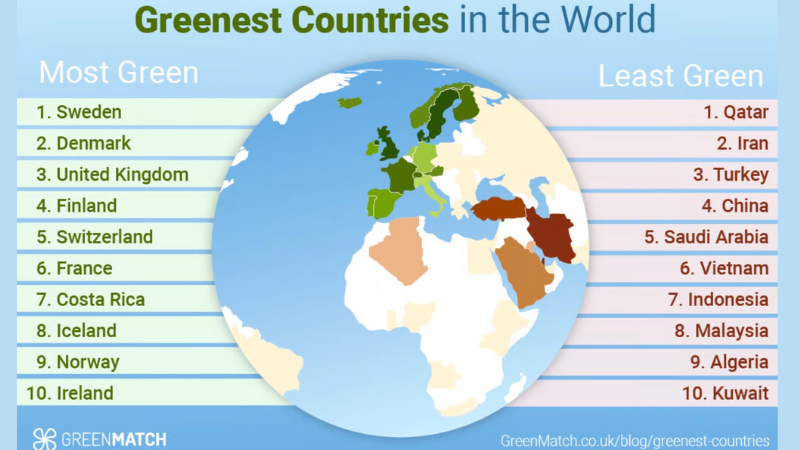
Below are the Top 10 Greenest Countries in the World, based on combined, up-to-date data.
🌍 The Top 10 Greenest Countries in the World
1️⃣ Sweden
Sweden consistently performs at a high level across sustainability measures. It excels in ecosystem protection, renewable energy innovation, and marine conservation, while maintaining some of the cleanest air in Europe.
Like many developed nations, its main challenge remains reducing per-capita CO₂ emissions — though it continues to outperform most of the world.
2️⃣ Denmark
Denmark is widely recognised as a pioneer in sustainability. It ranks at or near the top for environmental policy, renewable energy, and wastewater treatment.
Every household is connected to treated wastewater systems — a quiet but powerful indicator of sustainable infrastructure.
3️⃣ United Kingdom
The UK has made significant progress in recent years, ranking highly for climate policy and ecosystem protection.
Despite its industrial history, continued investment in renewable energy and environmental regulation shows how large economies can meaningfully shift toward sustainable living.
4️⃣ Finland
Finland stands out for clean innovation, ranking first globally in this category. It also records the lowest average air-pollution levels of all countries studied.
Its commitment to reducing fossil fuel dependence by 50% by 2030 places it firmly on a sustainable long-term path.
5️⃣ Switzerland
Switzerland achieves exceptional scores for drinking water quality and sanitation, contributing to some of the lowest public-health risk levels globally.
Its long-term plan to reach 100% renewable energy by 2050 highlights a forward-thinking approach to sustainability.
6️⃣ France
France was an early adopter of the UN Sustainable Development Goals and performs strongly in climate policy.
While emissions remain an area for improvement, consistent regulation and renewable investment keep France among the world’s greener nations.
7️⃣ Costa Rica
Costa Rica remains a global sustainability icon, particularly for biodiversity protection and renewable energy.
Although it ranks lower overall in some composite indexes, it performs exceptionally well in year-on-year emissions reduction, demonstrating meaningful progress over time.
8️⃣ Iceland
Powered largely by geothermal and hydroelectric energy, Iceland benefits from some of the cleanest air in the world.
Ambitious targets to become fossil-fuel-free by 2050 suggest its sustainability performance will continue to improve.
9️⃣ Norway
Norway leads globally in green transport, particularly electric vehicle adoption.
While emissions from energy production remain a challenge, national targets aim to reduce greenhouse gases by up to 95% by 2050.
🔟 Ireland
Ireland performs strongly in air quality and social sustainability and has committed to reaching net zero by 2050.
Like many nations, its sustainability journey is well underway, with policy momentum continuing to build.
Do People’s Perceptions Match the Data?
Largely — yes.
Global surveys measuring lived experience of sustainability show strong alignment with the data-driven rankings. Countries that score highly for air quality, waste management, green infrastructure, and environmental policy are also rated highly by residents and expatriates.
This matters, because sustainable living only works when it’s felt in everyday life — not just measured in reports.
What the Greenest Countries Teach Us About Sustainable Living at Home
The world’s greenest countries didn’t achieve progress through perfection.
They focused on systems that quietly reduce waste, protect resources, and work long-term — making sustainable choices the default, not the exception.
The same principle applies at home.
Choosing a refillable soap system designed for sustainable living is one of the simplest ways to reduce everyday waste without changing how your home functions.
Sustainable Living Is Built on Everyday Systems
Sustainable living isn’t about doing everything.
It’s about doing better things consistently:
-
Refillable instead of disposable
-
Long-lasting instead of throwaway
-
Thoughtfully designed systems that reduce waste without effort
Swapping liquid hand wash for solid soap that eliminates single-use plastic bottles is a small daily habit that adds up to a meaningful reduction in plastic waste over time.

Haircare is another major source of household plastic. Switching to a sustainable alternative to liquid shampoo can remove dozens of plastic bottles per household each year — without compromising on performance or experience.

For those looking to get started easily, simple sustainable living swaps for your home make it possible to remove multiple single-use products in one calm, practical change.
Sustainable Living Starts With Choices You’ll Stick With
At SNOAP, we believe sustainability should be simple, beautiful, and built into daily routines — not something that feels complicated or extreme.
The most sustainable choice isn’t the most radical one.
It’s the one you’ll still be making next year.

Sources & Further Reading
This article draws on data and insights from the following respected international sources:
-
Environmental Performance Index (EPI) — Yale University
-
Green Future Index (GFI) — Massachusetts Institute of Technology (MIT)
-
EU Joint Research Centre (JRC) sustainability reports
-
IQAir Global Air Quality Data
-
InterNations Expat Sustainability Survey
Additional reference material:
https://www.greenmatch.co.uk/blog/greenest-countries